Riverview FL Roofing Contractor · Serving Ruskin & the South Shore
Roofers in Ruskin, FL
Roof repair, replacement and storm help for Ruskin homes — from the Cypress Creek subdivisions to the Little Manatee River, and everywhere the salt air reaches.
The short answer
Need a roofer in Ruskin? Most roofs here are architectural shingle, metal or tile, and most of the calls are leaks, missing shingles, storm damage — and shingle roofs from the 2000s building boom that are simply wearing out. Ruskin is unincorporated Hillsborough County, so there is no city building department: your job runs on a county permit, and it should be pulled, inspected and closed properly. We’re based up the South Shore in Riverview and work Ruskin every week. Call (813) 471-5632 — the line is answered around the clock.
Ruskin sits about three feet above Tampa Bay — the Census puts the town’s elevation at 3.3 feet. That one fact explains most of what we see on Ruskin roofs. Salt air works on every exposed fastener and piece of flashing. Summer rain arrives sideways. And hurricane season is not an abstract risk here: in September 2024, Hurricane Helene passed offshore in the Gulf and pushed a reported 6–8 feet of surge into Tampa Bay, and Hillsborough County ordered everyone in Evacuation Zone A — and every manufactured and mobile home in the county — to leave.
A roof in Ruskin does a harder job than a roof in Brandon or Valrico, and it ages faster doing it. This page is written for that reality: what Ruskin roofs are made of, how they fail, what the work honestly costs, and what to do before and after a storm. If you’d rather skip the reading, the number is (813) 471-5632.
Services
Roof repair Ruskin FL — and every other roof service we run
Everything below is roof work, done as roof work — permitted where Hillsborough County requires it and inspected when it’s finished. No handyman detours, no siding-and-windows upsell.
| Service | What it covers | The typical Ruskin call |
|---|---|---|
| Roof repair | Leak tracing and repair, missing or damaged shingles, cracked tile, flashing, soffit and fascia | A ceiling stain that shows up after a summer storm |
| Roof replacement | Full tear-off and re-roof in shingle, metal, tile or a flat/low-slope system | A 2000s-boom shingle roof at the end of its life |
| Storm damage repair | Wind-uplift inspection, emergency tarping, dated photo documentation for your insurer | “The storm’s passed — is my roof actually OK?” |
| Roof inspections | Condition and roof-age reports for buyers, sellers and insurance renewals | An insurer asking for proof of roof age and remaining life |
| Manufactured-home roofing | Roof-over systems, low-slope membranes, Florida-room and carport roofs | A leaking roof-over in one of Ruskin’s 55+ communities |
| Flat & low-slope roofs | TPO and modified bitumen for additions, porches, lanais and small commercial buildings | A Florida room roof that ponds water after every rain |
| Gutters, soffit & fascia | Replacement and repair, tied into the roof job so the edges seal as one system | Fascia rotting behind gutters that failed years ago |
Not sure which row you’re in? That’s normal — most people aren’t. A leak over the kitchen can be a flashing failure, a cracked tile or wind-lifted shingles three courses up. The inspection is what sorts it, and it starts with a call: (813) 471-5632.
Local knowledge
Ruskin homes — and what the mix means for your roof
Ruskin is not one kind of town, and that’s the first thing a roofer here has to understand. It was founded in 1908 on the Little Manatee River as a farming and fishing community, and the 2020 Census counted 28,620 people, with about three in four homes owner-occupied and a median owner-occupied value of $323,000. Inside those numbers sit four very different kinds of housing — and each one fails in its own way.
The 2000s-boom roofs
When the farms east and south of the old town turned into subdivisions, thousands of shingle roofs went on within a few years of each other — Cypress Creek’s homes, for example, date from 2007 to 2022. A shingle roof installed in 2008 has now spent eighteen Florida summers under UV, humidity and storm seasons. If yours is original to the house, it is in the window where an honest inspection matters more than another patch.
The historic core
The oldest part of Ruskin sits east of US 41 along the Ruskin Inlet — smaller homes, mixed roof materials, and repairs layered over repairs across decades. On these roofs the open question is rarely the shingles you can see; it’s the decking and the old work underneath them.
Waterfront homes
Bahia Beach and Little Harbor on Tampa Bay, Shell Point, and the riverfront along the Little Manatee: beautiful, and the hardest environment a roof can work in. Salt air corrodes exposed fasteners and flashing years ahead of schedule, which is why material choice — and what the fasteners are made of — matters more on these streets than anywhere else in Ruskin.
Manufactured homes
Housing listings for Ruskin count roughly 1,255 mobile and manufactured homes alongside the site-built stock — Riverside Club, Shell Pointe, Chulavista Landings and streets of older manufactured homes throughout town. Low-slope roofs, roof-overs and Florida rooms are their own trade, and they get their own section below.
And the mix is still changing: new construction like Ruskin Reserve, near US-41 and I-75, is adding fresh roofs every year. A new roof isn’t a finished subject, though — builder-grade installations still deserve a look before their first full storm season.
Materials
Shingle, metal, tile or flat — an honest comparison
Every Ruskin roofer works in the same four material families. What differs is whether anyone tells you the downside of the one they’re selling. Here is the version we’d give family:
| Material | Where you see it in Ruskin | Honest strengths | Watch out for |
|---|---|---|---|
| Architectural shingle | Most subdivisions — still the most popular pick locally | Lowest installation cost of the group, fast to install, strong wind-rated options | Shortest service life under Florida sun; black algae streaking; real-world performance depends heavily on the wind rating and the nailing pattern |
| Standing-seam metal | Waterfront homes, Bahia Beach, newer builds | Aluminium and Galvalume panels shrug off salt air; long service life; no exposed fasteners to back out | Highest upfront cost of the common options; cheaper exposed-fastener metal is a different product and needs its fasteners maintained |
| Tile — clay & concrete | Mediterranean-style homes, Little Harbor, custom builds | The tile itself can outlast everything beneath it; handles heat well | The underlayment usually fails first — many “tile roof replacements” are really re-felting and resealing jobs; cracked tiles and roof weight |
| Flat / low-slope | Florida rooms, additions, lanais, commercial along US-41 & College Ave | TPO and modified bitumen are the right systems for slopes shingles can’t handle | Ponding water and seams are the whole game — drainage design matters more than the membrane brand |
Why the waterfront picks metal
On the bay side of Ruskin, the argument for standing-seam metal isn’t fashion — it’s corrosion. Salt air eats ordinary fasteners and flashing, and a standing-seam roof in aluminium or Galvalume has no exposed fasteners to eat. Inland, on a Cypress Creek shingle street, the maths is different and a quality architectural shingle is often the sensible spend. The right answer depends on which side of US-41 you sleep on — anyone who gives you one answer for all of Ruskin isn’t listening.
One more thing you won’t read elsewhere: nobody publishes a trustworthy market share for these materials in Ruskin, so be suspicious of any page that tells you “62% of Ruskin homes have…” — including ours, if we ever wrote it. We’d rather tell you what we actually see on Ruskin roofs, and it’s the four systems above.
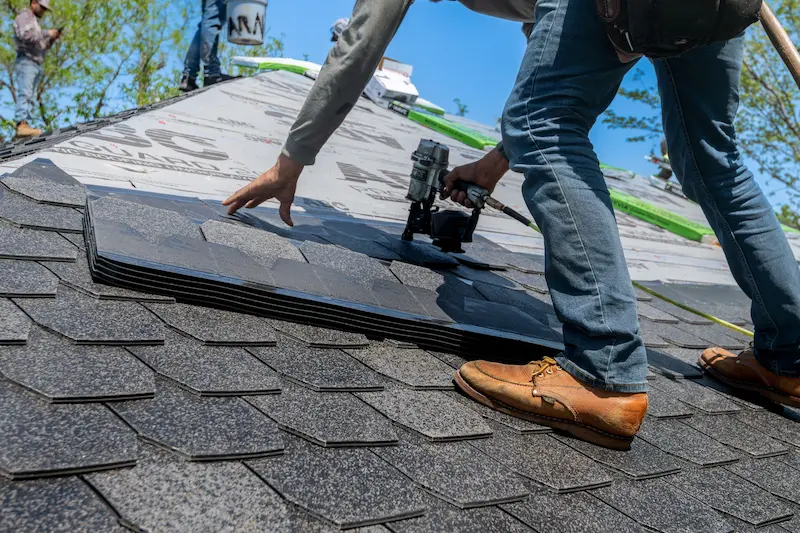
Architectural shingles going on — the nailing pattern and wind rating are what decide how a roof meets its first hurricane.
Storm season
Storm damage roof Ruskin — the playbook
Ruskin learned two opposite lessons in the autumn of 2024. Helene, in September, never made landfall here — it passed offshore and still drove a reported 6–8 feet of surge into Tampa Bay, flooding low ground along the bay and the Little Manatee River; at least one riverfront Ruskin home was afterwards listed for sale as Helene-flooded, sold as-is. A month later Milton came ashore south of Tampa and its winds blew the water out of the bay. Same coastline, two completely different kinds of damage.
The distinction that decides your claim
Wind and rain damage the roof. Surge and flood damage the house. They are different damage, handled by different insurance, proven with different paperwork. A roof claim is about uplift, missing shingles, broken tile and rain driven in through the damage. Water that rose from the ground or the river is flood territory, not a roof claim — no roofer can honestly turn one into the other, and you should run from one who offers to.
Before the season (June is too late to start in June)
- Get the roof looked at in spring. Lifted shingle edges, cracked tiles and rusted flashing are exactly what hurricane wind gets its fingers under.
- Photograph all four sides from the ground. Dated “before” photos are the strongest evidence a claim can have.
- Know your evacuation zone. In Helene, the county ordered Zone A out — and every manufactured and mobile home in Hillsborough County, whatever the zone. If that order names your home, the roof conversation waits; you go.
- Check the attic on a dry day. Daylight where it shouldn’t be, or damp insulation, is a leak that a storm will turn into a ceiling.
After a storm
- Safety first. Never climb on a wet, damaged roof. Every check below can be done from the ground or by us.
- Photograph everything before it’s touched — the roof, the debris in the yard, any water marks inside. Then photograph it again after tarping.
- If water is coming in, get it tarped and keep the receipt. Temporary mitigation is what your insurer expects you to do, and the receipt is part of the record.
- Get an inspection that looks for hidden damage — loosened fasteners, lifted seals, stripped granules, moisture that has found a path in. The damage that matters is often not the shingle in your driveway.
- File with the documentation together: dated photos, the inspection notes, the tarp receipt. Claims move faster when the story is already assembled.
One last thing about storms and roofs: the damage is cumulative. Every season works fasteners a little looser, strips a little more granule, worries at every seal. A roof can shrug off three hurricanes and then fail in an ordinary October rain — not because the rain was special, but because the roof had been spending its strength for years. That’s why the spring inspection is on this page twice.
The gap nobody covers
Manufactured home roofing Ruskin FL
Search for Ruskin roofing pages and you’ll find plenty about shingle subdivisions — and almost nothing about the manufactured homes that make up a real share of this town: around 1,255 of them in local housing counts, in communities like Riverside Club (the 55+ golf-and-marina community on Pier Drive), Shell Pointe on the Little Manatee, and Chulavista Landings, plus older manufactured homes on streets throughout Ruskin. Those roofs need a roofer too. This section is for them.
What goes wrong on a manufactured roof
- The original roof ages out. Older metal and rubber roofs reach a point where seam sealant and patching stop being a plan.
- Low slope means standing water. These roofs are nearly flat; water that ponds finds every weak seam eventually.
- The Florida room leaks first. The addition and carport roofs — usually a different, cheaper system than the main roof — are the most common leak source we’re called about.
- Storm exposure is higher. In Helene, Hillsborough County ordered every manufactured home evacuated. A sound, well-fastened roof-over is part of how these homes ride out the seasons between evacuations.
The honest options
- Roof-over systems — a new roof system installed over the existing one, adding a sealed, insulated layer without stripping the home open. The standard answer for sound structures with a tired roof skin.
- Membrane systems — for the flattest roofs and for Florida-room and carport sections, where a membrane handles standing water better than any seamed metal.
- Targeted repair — seams, penetrations and the addition roofs, when the main roof genuinely has life left. We’ll tell you if that’s your situation; a roof-over sold to a home that needed a $400 seam repair is exactly the kind of sale this page exists to argue against.
Living in Riverside Club, Shell Pointe, Chulavista Landings, Little Manatee South — or a manufactured home anywhere else in 33570–33575? Call (813) 471-5632 and say the words “manufactured home” first. The conversation is different, and it should start different.
Pricing, in the open
What a roof costs in Ruskin
Any roofer who gives you a firm Ruskin price without measuring your roof is guessing with your money. What we can honestly put in print is what the market around you publishes — so you can walk into any estimate, ours included, knowing the shape of a fair number.
Published figures, with their sources
- ≈ $12,000 average for a shingle roof in Ruskin — published by PITCH Roofing, which keeps a Ruskin office. Their page gives no roof size or scope for that average, so treat it as a marker, not a quote. (pitchroofing.com/ruskin)
- $9,000–$18,000 for many Tampa-area replacements, and for a 2,000 sq ft home, architectural shingle at $12,000–$27,000, exposed-fastener metal at $18,000–$30,000 and standing seam at $28,000–$50,000 — published Hillsborough/Tampa ranges from Steadfast Roofing’s cost guides. (steadfastroofingfl.com)
- $9,000–$18,000 for shingle replacement across Tampa/Hillsborough — FloridaRoofers.org’s shingle cost guide, independently in the same range. (floridaroofers.org)
- One figure we won’t repeat as real: an aggregator page prints $828 for a Ruskin roof repair and $6,085 for an installation. That sits far below every contractor range published for this county, and the method behind it isn’t shown. If a number looks too good to check, check it.
What actually moves your quote
- Size and pitch — the two measurements everything else hangs off.
- Tear-off layers — a second old roof underneath doubles the strip and disposal work.
- Decking condition — only visible at tear-off; a written per-sheet price agreed before work starts is how honest roofers handle it.
- Material and wind rating — on the coast, the rating is not an upsell, it’s the product.
- Code upgrades — replace enough of a roof in a year and current code can apply to the whole section (see Permits, below).
- Complexity — valleys, penetrations, chimneys, and Florida-room tie-ins all add labour.
Our part of the bargain: we measure the roof, and the number goes in writing, itemised — tear-off, decking, underlayment, material, flashing, disposal — so you can compare it line by line against anyone else’s. That starts with a call to (813) 471-5632.
Paperwork, plainly
Permits & insurance in Ruskin, in plain language
The permit
Ruskin is unincorporated — there is no City of Ruskin building department to visit. Roofing permits here are Hillsborough County permits, issued through the county’s Development Services, and on any proper job your roofer pulls the permit, the work gets inspected, and the permit gets closed. Three questions sort the serious roofers from the rest: Will you pull the permit? Can I have the permit number? Who schedules the inspection? Any hesitation on those is your answer.
The 25% rule
Under the Florida Building Code as it’s commonly applied, once repairs or replacement pass 25% of a roof’s area within a 12-month period, the whole roof section generally has to be brought up to current code — not just the patched part. It’s the rule that turns “a few more repairs” into a bigger conversation, and it’s why a roofer who knows your roof’s repair history is worth having before the third patch, not after. One exception matters: if the roof was built or last re-roofed under the 2007 Florida Building Code or later, only the part being worked on has to meet current code.
The insurance roof-age problem
Florida insurers look hard at roof age, and Ruskin’s 2000s-boom housing stock means thousands of local roofs are hitting the ages insurers question. What many homeowners never get told: Florida Statute 627.7011 addresses exactly this — an insurer cannot refuse or non-renew a policy solely because of a roof’s age when an inspection shows the roof has five or more years of useful life remaining. That makes a proper roof inspection — documented, dated, specific about remaining life — a financial document, not just a maintenance one. It’s one of the most valuable calls a Cypress Creek homeowner with a 2008 roof can make.
A wind-mitigation inspection can also document the features insurers credit — roof-to-wall straps or clips, secondary water resistance, opening protection. We won’t quote you a discount percentage for those, because anyone who guarantees one is guessing at your insurer’s math. Document the features; let the insurer price them.
Coastal maintenance
Algae, ventilation & salt air — the slow damage
Storms get the headlines, but most Ruskin roofs are worn down by three quieter things.
The black streaks are alive
Those dark streaks running down shingle roofs all over Ruskin are, in most cases, a cyanobacterium called Gloeocapsa magma. It feeds on the limestone filler in asphalt shingles, thrives on heat, humidity and dew, and hits north-facing and tree-shaded slopes hardest. It isn’t just ugly: the growth holds moisture against the roof and speeds up granule loss. Two cautions — pressure-washing a shingle roof strips the granules that are the shingle’s protection, so cleaning means a soft wash; and when a roof is replaced, algae-resistant shingles exist precisely because of this organism.
A hot attic cooks the roof from below
Poor attic ventilation is one of the most common problems Ruskin roofers list, and in a humid coastal town it works both ways: trapped heat ages shingles from underneath, and trapped moisture feeds mould in the attic. If your upstairs rooms run hot and the roof is ageing faster than the neighbours’, ventilation belongs in the conversation alongside the shingles.
Salt air is a maintenance item, not a surprise
Within reach of the bay and the river, exposed metal — fasteners, flashing, vents — corrodes on a schedule you can set a watch by. An annual look at the flashing lines and any exposed fastener heads, from the ground with binoculars or by us from the roof, catches rust while it’s still a tube of sealant and a wire brush, not a leak over the living room.
Three checks that cost nothing
1 · Streaks spreading on the shaded slope? That’s algae, and it’s eating slowly.
2 · Attic damp or musty after rain? Water is getting in somewhere above you.
3 · Rust freckles on flashing or fasteners? Salt air has started its work. Any one of the three earns a call — (813) 471-5632.
Where we work
Neighbourhoods we cover in Ruskin
All of Ruskin — named street by street, not just the town name in a list. We run US-41 and College Avenue out to I-75 Exit 240, down 19th Avenue toward E.G. Simmons Park, and the Shell Point Road corridor to the river.
ZIP codes: 33570 · 33571 · 33572 · 33573 · 33575
And the rest of the South Shore
This page is about Ruskin — but the same crew is based just up the road in Riverview and works the neighbouring South Shore towns too:
Straight talk
How to choose a Ruskin roofer
Every roofing page in Ruskin calls itself some version of the best. Superlatives cost nothing to print, so judge on paperwork instead. Before you sign with anyone — us included — get straight answers to these:
- Who pulls the permit, and can I have the number? In unincorporated Ruskin it’s a county permit, and a real roofer hands the number over without blinking.
- Is the estimate itemised, in writing? Tear-off, decking, underlayment, material, flashing, disposal — line by line, so quotes can actually be compared.
- What wind rating, and what nailing pattern? Three feet above Tampa Bay, those two answers decide how your roof meets its first hurricane.
- What happens if the decking is rotten? The price for that should be agreed before the tear-off, not negotiated over an open roof.
- After a storm, did they knock — or did you call? The door-knocker who wants a signature before anyone has taken a photograph is selling something other than roofing.
Our answers, for the record: we pull the county permit, we write the estimate itemised, we’ll talk wind rating and nailing pattern as long as you want, and the decking price is agreed before we open your roof. We’re a Riverview-based crew — Ruskin is down the South Shore from us, and it’s on our run every week. Judge us by the same list.
Questions
Ruskin roofing FAQs
How much does a new roof cost in Ruskin, FL?
It depends on size, pitch, material and what the tear-off finds, but published local figures give you the shape: PITCH Roofing publishes around $12,000 as an average for a Ruskin shingle roof, Hillsborough/Tampa cost guides put many replacements at $9,000–$18,000, and a 2,000 sq ft home at $12,000–$27,000 in architectural shingle or $28,000–$50,000 in standing-seam metal. Your number comes from measuring your roof — call (813) 471-5632 and we’ll put it in writing, itemised.
Does Ruskin require a permit for roof work?
Yes — through the county. Ruskin is unincorporated, so there’s no city building department; roofing permits are Hillsborough County permits. On a proper job your roofer pulls the permit, the work is inspected, and the permit is closed. Ask any roofer for the permit number — it’s the simplest trust test there is.
My roof went on during the 2000s building boom. Should I be worried?
Not worried — attentive. A shingle roof installed in 2007–2010 has now spent 16–19 Florida summers under UV, humidity and storm seasons, and it’s entering the age where insurers start asking questions. An inspection now tells you whether you have years left, need targeted repairs, or should plan a replacement on your schedule instead of a storm’s.
Did Hurricane Helene damage Ruskin roofs?
Helene’s Ruskin story was mostly water: passing offshore in September 2024, it drove a reported 6–8 feet of surge into Tampa Bay, the county evacuated Zone A and every manufactured home, and low-lying and riverfront properties flooded. Roof damage from wind and driven rain happened too — but keep the two separate in your mind and your paperwork, because surge/flood and roof damage are different claims on different policies.
Do you roof manufactured and mobile homes?
Yes. Ruskin has around 1,255 manufactured homes, including Riverside Club, Shell Pointe and Chulavista Landings, and they need roof-overs, membrane systems for low slopes, and Florida-room and carport roof work — a different conversation from a shingle subdivision roof. Call (813) 471-5632 and say “manufactured home” first so we start in the right place.
What are the black streaks on my shingles?
In most cases, a cyanobacterium called Gloeocapsa magma. It feeds on the limestone filler in asphalt shingles, thrives in Ruskin’s heat and humidity, and shows worst on shaded, north-facing slopes. It holds moisture against the roof and speeds up granule loss, so it’s worth dealing with — with a soft wash, never a pressure washer, which strips the granules that protect the shingle.
My insurer says my roof is too old. What can I do?
Fla. Stat. 627.7011(5) bars refusal to issue or renew a homeowner’s policy solely because of roof age if the roof is under 15 years old. For roofs 15 or older, insurers must allow inspection by an authorized inspector at your expense before requiring replacement, and cannot refuse solely for age if it shows 5+ years of life left. It covers age alone, not poor condition or lawful reasons, and excludes mobile home policies. Call (813) 471-5632 for an inspection.
My tile roof is leaking. Do I need a whole new roof?
Often, no. On tile roofs the underlayment usually fails years before the tile does, so many leaking tile roofs need the tile lifted, the underlayment replaced (re-felting) and the tile re-set — not a full new roof. Cracked and slipped tiles still need individual attention, and the inspection is what tells you which job yours is.
How fast can you get to a leaking roof?
The phone line is answered 24/7, including storm nights — call (813) 471-5632 and you’ll talk to us, not a form. If water is actively coming in, the first job is tarping and documentation; the inspection and the repair plan follow from what the roof actually looks like, not from a guess over the phone.
Which parts of Ruskin do you cover?
All of it — Cypress Creek and its Orchids, Vines and Maples subdivisions, Bahia Beach and Little Harbor, Shell Point and Shell Pointe, Riverside Club, Ruskin Reserve, Little Manatee South, Chulavista Landings, the historic core east of US 41, and every ZIP: 33570, 33571, 33572, 33573 and 33575. We also work Riverview, Apollo Beach, Gibsonton, Brandon and Valrico.
Talk to a roofer, not a call centre
Leak, storm damage, an insurer asking hard questions, or a 2008 roof you’ve started to wonder about — one call sorts out which it is.
Call (813) 471-5632 — 24/7Sources
Where the facts on this page come from
- Ruskin population (28,620), elevation (3.3 ft), owner-occupancy (75.4%), median home value ($323,000), ZIP codes — U.S. Census QuickFacts, Ruskin CDP, and Wikipedia, “Ruskin, Florida”: census.gov/quickfacts · en.wikipedia.org/wiki/Ruskin,_Florida
- Founding (1908), historic core east of US 41, Bahia Beach, Little Manatee River corridor — The Ruskin Community Plan: docest.com/doc/3827
- E.G. Simmons Conservation Park (2401 19th Ave NW; 258 acres of mangroves; 200-acre sanctuary) — Hillsborough County: hcfl.gov/locations/eg-simmons-conservation-park
- Little Manatee River (about 40 miles; Outstanding Florida Water, 1982) — USF Water Atlas: hillsborough.wateratlas.usf.edu
- Cypress Creek subdivisions and build years (2007–2022) — neighborhoods.com/cypress-creek-ruskin-fl; Riverside Club (2550 Pier Dr) — newhomesource.com; manufactured-home count (1,255) — city-data.com housing table (aggregator count, vintage not stated)
- Helene surge (6–8 ft modelled for Tampa Bay), Zone A and manufactured-home evacuation orders — NHC modelling as reported: lisamillerassociates.com; Milton’s offshore winds on Tampa Bay — USF Water Atlas: tampabay.wateratlas.usf.edu
- Pricing — PITCH Roofing Ruskin page (shingle average ≈ $12,000; material notes): pitchroofing.com/ruskin; Steadfast Roofing Tampa cost guides ($9k–$18k; per-material ranges): steadfastroofingfl.com; FloridaRoofers.org Hillsborough shingle guide: floridaroofers.org
- Common Ruskin repairs, ventilation and hurricane-ageing mechanisms — competitor Ruskin pages as researched: classicroofreplacement.com/areas-we-serve/ruskin · steadfastroofingfl.com/roofing · mitchellroofingcompanyllc.com (the 25% rule: Florida Building Code — Existing Building §706.1.1, 8th Edition, with the 2007-code exception per Fla. Stat. §553.844(5); the Stat. 627.7011(5) roof-age point is verified against the 2025 Florida Statutes text via FindLaw and Justia)
- Algae (Gloeocapsa magma) — Florida roofing guidance: paletzroofing.com/mold-on-shingles · robertjonesroofing.com