RIVERVIEW FL ROOFING CONTRACTOR · SERVING SUN CITY CENTER & THE SOUTH SHORE
ROOFERS IN SUN CITY CENTER, FL
Roofers In Sun City Center, FL
Roof repair, replacement and storm help for Sun City Center homes — from Kings Point to the Pebble Beach corridors, and everywhere the association has a say.
Call (813) 471-5632 What a Sun City Center roof costs
- 24/7 emergency line
- Permitted & inspected work
- ZIPs 33571 · 33573
The Short Answer
Need a roofer in Sun City Center? Most roofs here are architectural shingle, tile or metal over single-story concrete-block homes, and most calls are leaks, worn-out pipe boots and flashing — and roofs from the community’s big building years that have simply reached their age. Two things make this town different from every other stop on our run: the Community Association has a say in what goes on your roof, and a large share of the homes sit empty for months at a time. We’re based up the road in Riverview and work the South Shore every week. Call (813) 471-5632 — the line is answered around the clock.
Sun City Center is a town a developer drew on purpose. Del Webb began building it in 1961 as a retirement community, and it is still exactly that: the Census Bureau’s latest survey counts about 33,500 residents with a median age of 69, and close to six in ten residents over 65. There is no city government and no city building department — this is unincorporated Hillsborough County, so your roof job runs on a county permit, pulled, inspected and closed properly.
A roof here does a particular job. It sits over a one-story home, under a Florida sun that never really leaves, in a community where the association reviews what your roof looks like and your insurer reviews how old it is. This page is written for that reality: what these roofs are made of, the two approvals questions to settle before anyone tears anything off, what the work honestly costs, and how to handle the insurance roof-age problem that hangs over half the streets in town. If you’d rather skip the reading, the number is (813) 471-5632.
SERVICES
Roof Repair Sun City Center FL — And Every Other Roof Service We Run
Everything below is roof work, done as roof work — association approval sorted where the community requires it, permitted where Hillsborough County requires it, and inspected when it’s finished. No handyman detours, no siding-and-windows upsell.
Roof repair
Leak tracing and repair, pipe boots, flashing, cracked tile, valley and vent work
A ceiling stain in a home that’s been closed up since spring
Roof replacement
Full tear-off and re-roof in shingle, tile, metal or a flat/low-slope system
A 1990s roof the insurer has started asking about
Roof inspections
Condition and roof-age reports for insurance renewals, buyers and sellers
“My insurer says my roof is too old — is it?”
Storm damage repair
Wind-uplift inspection, emergency tarping, dated photo documentation for your insurer
“The storm’s passed — is my roof actually OK?”
Tile roof work
Cracked and slipped tile, and underlayment replacement (re-felting) under sound tile
A leak on a tile roof whose tile still has years left
Flat & lanai roofs
TPO and modified bitumen for lanai, carport and Florida-room roofs
A lanai roof that ponds water after every rain
Gutters, soffit & fascia
Replacement and repair, tied into the roof job so the edges seal as one system
Fascia softening behind gutters that failed years ago
Not sure which row you’re in? That’s normal — most people aren’t. On a one-story ranch, a stain over the living room can be a perished pipe boot, a cracked tile two courses up, or flashing that let go a season ago. The inspection is what sorts it, and it starts with a call: (813) 471-5632.
LOCAL KNOWLEDGE
Sun City Center Homes — And What The Mix Means For Your Roof
This community was built in waves, and each wave left a different roof behind.
The Del Webb-Era Homes
The oldest streets date from the 1960s and 1970s — concrete-block ranch homes built when the community was new. The ones still wearing anything close to an original roof system are rare; what you actually find is decades of layered work: re-roofs over old felt, patches over patches, and underlayment that has been baked brittle by fifty Florida summers. On these roofs the honest first question is what the tear-off will find, and the estimate should say so.
The 1970s–1990s Building Years
The bulk of Sun City Center — street after street of single-story villas and ranches — went up between the 1970s and the 1990s. Their roofs have mostly been replaced once already, in the 2000s or 2010s, which puts a large share of the town in the same position at the same time: shingle and tile roofs now 15 to 25 years old, in a state where insurers start asking hard questions at exactly that age. That is not a sales line; it is the arithmetic of when this town was built, and it is why the insurance section below matters more here than anywhere else we work.
Kings Point
Behind the gates off Sun City Center Boulevard sits Kings Point — its own world, with its own Federation, its own management, and thousands of attached villas and condos alongside single-family homes. Kings Point changes the roofing conversation in one specific way, and it gets its own section below: in many of its condo and villa associations, the roof over your home is the association’s roof, carried in your community fees. In a Kings Point single-family home, it’s yours. Knowing which one you’re standing under comes before any estimate.
The Newer Edges
Communities like Renaissance and Cypress Village, and the assisted-living homes around Aston Gardens and Freedom Plaza, are newer construction with newer roofs — not today’s problem, but builder-grade installations still deserve a look before their first full storm seasons, and their associations have their own rules about who works on a roof and how.
MATERIALS
Shingle, Tile, Metal Or Flat — An Honest Comparison
Every roofer working this town installs from the same four families. What differs is whether anyone tells you the downside of the one they’re selling. Here is the version we’d give family:
| Material | Where you see it in Sun City Center | Honest strengths | Watch out for |
|---|---|---|---|
| Architectural shingle | Most streets in town — still the most common roof here | Lowest installation cost of the group, fast to install, strong wind-rated options | Shortest service life under Florida sun; black algae streaking; the association must approve the colour |
| Tile — clay & concrete | Kings Point and the Mediterranean-style homes | The tile itself can outlast everything beneath it; handles heat well | The underlayment usually fails first — many “tile replacements” are really re-felting jobs; some approved profiles are slow to source |
| Standing-seam metal | Growing on ranches across the community | Long service life, no exposed fasteners to back out, sheds heat well | Highest upfront cost of the common options; profile and colour must clear association review before it goes on |
| Flat / low-slope | Lanais, carports, Florida rooms, villa sections | TPO and modified bitumen are the right systems for slopes shingles can’t handle | Ponding water and seams are the whole game — drainage design matters more than the membrane brand |
One correction you deserve in print, because two roofing pages for this town get it wrong: Sun City Center is not in the High-Velocity Hurricane Zone. The HVHZ is Miami-Dade and Broward counties, at the other end of the state. Your roof is built and permitted to the Florida Building Code’s wind requirements for Hillsborough County — serious requirements, honestly enforced, and quite enough without borrowing Miami’s label to sell you a heavier roof than you need.
And the same honesty in the other direction: nobody publishes a trustworthy market share for these materials in Sun City Center, so be suspicious of any page that tells you “62% of homes here have…” — including ours, if we ever wrote it. We’d rather tell you what we actually see on these roofs, and it’s the four systems above.
THE GAP NOBODY COVERS
The Gap Nobody Covers: Two Questions Before Any Tear-Off
Search for Sun City Center roofing pages and you’ll find prices, materials and storm advice. What almost none of them walk you through is the part that is unique to a planned community like this one — and it’s the part that can stop a job cold.
Question One: Has The Association Approved This Roof?
Most Sun City Center homeowners are members of the Sun City Center Community Association, and the association’s architectural review covers exterior changes — a new roof’s material and colour included. On top of that, many subdivisions have their own architectural review boards written into their covenants. Roofers who work this community describe the failure mode plainly: an out-of-town crew tears off a roof, installs a profile or colour that was never approved, and the job gets halted while the homeowner sits under exposed decking waiting on a committee. The fix costs nothing but sequence: the approval goes in before the tear-off, with the exact material, profile and colour named in it. Ask any roofer bidding your job — us included — who prepares that submittal and when. “We’ll sort it out later” is the wrong answer, and on this side of the county line it’s an expensive one.
Question Two: Whose Roof Is It?
In Kings Point’s condo and villa associations, listings for homes state it outright: community fees include roof coverage — the roof is the association’s to maintain and replace, and the association’s contractor does the work. Calling your own roofer to replace a roof the association owns wastes everyone’s time and can put you on the wrong side of your own covenants. In a single-family home — in Kings Point or anywhere else in town — the roof is yours, full stop. So the first step of any Kings Point roof job is a five-minute check of your association documents or a call to the management company. If the roof turns out to be yours, the rest of this page applies. If it’s theirs, you just saved yourself an estimate you never needed.
Living in Kings Point, Cypress Village, Renaissance, St. Andrews — or anywhere else in 33571–33573? Call (813) 471-5632 and tell us which community you’re in first. The conversation starts differently depending on the answer, and it should.
Leak, storm damage, an insurer asking hard questions, or a roof the association has questions about — one call sorts out which it is.
STORM SEASON
Storm Damage Roof Sun City Center — The Playbook
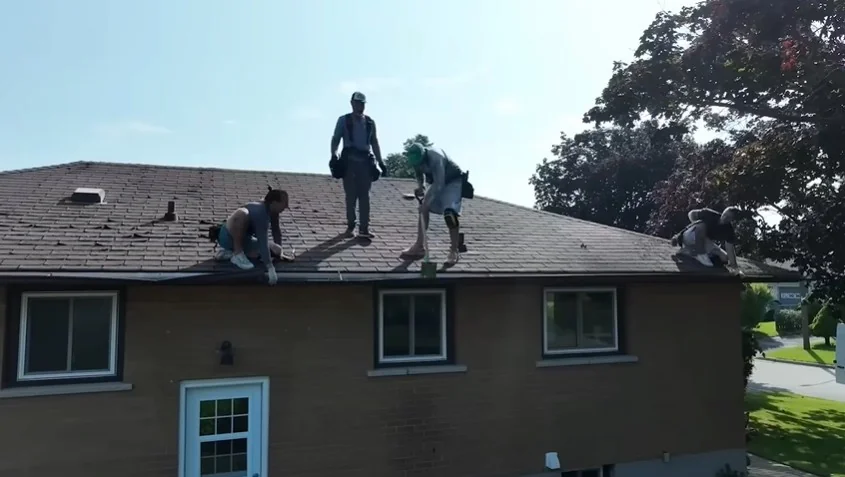
Sun City Center sits inland, several miles from Tampa Bay, and that changes its storm problem. Ruskin and Apollo Beach worry about surge; this town’s roofs worry about wind and driven rain — gusts working at shingle edges and tile, rain pushed sideways under flashing, and the big oaks this community is shaded by coming down on one-story roofs. The damage that matters here is on the roof itself, which is the good news: it’s also the damage a roofer can actually document and fix.
Before The Season (June Is Too Late To Start In June)
- Get the roof looked at in spring. Lifted shingle edges, cracked tiles and perished pipe boots are exactly what hurricane wind gets its fingers under.
- Photograph all four sides from the ground. Dated “before” photos are the strongest evidence a claim can have.
- If the house will sit empty, say so. A part-time home needs its roof checked before you leave, not after you come back to a stain — a small leak in an empty house runs for months and becomes a ceiling, then a floor.
- Know your evacuation zone. Inland is not exempt; Hillsborough County orders zones by risk, and manufactured homes are ordered out county-wide. If the order names your home, the roof conversation waits; you go.
After A Storm
- Safety first. Never climb on a wet, damaged roof. Every check below can be done from the ground or by us.
- Photograph everything before it’s touched — the roof, the debris in the yard, any water marks inside. Then photograph it again after tarping.
- If water is coming in, get it tarped and keep the receipt. Temporary mitigation is what your insurer expects you to do, and the receipt is part of the record.
- Get an inspection that looks for hidden damage — loosened fasteners, lifted seals, cracked tile, moisture that has found a path in. The damage that matters is often not the shingle in your driveway.
- File with the documentation together: dated photos, the inspection notes, the tarp receipt. Claims move faster when the story is already assembled.
One last thing about storms and roofs: the damage is cumulative. Every season works fasteners a little looser, strips a little more granule, worries at every seal. A roof can shrug off three hurricanes and then fail in an ordinary October rain — not because the rain was special, but because the roof had been spending its strength for years. That’s why the spring inspection is on this page twice.
PRICING IN THE OPEN
What A Roof Costs In Sun City Center
Any roofer who gives you a firm price for your home without measuring your roof is guessing with your money. What we can honestly put in print is what the market around you publishes — so you can walk into any estimate, ours included, knowing the shape of a fair number.
Published Figures, With Their Sources
$350–$750 for a small repair; $750–$1,500 for a moderate one
— published Sun City Center pricing from Brennan Roofing, a Tampa company that works this town: pipe boots, flashing and underlayment sections sit in those bands. Their table also puts a roof inspection at $150–$350.
(brennanroofingcotampa.com/sun-city-center-fl/)
$4.50–$7.00 per square foot for architectural shingle replacement; $8.00–$14.00 for barrel tile
— the same published table. On a typical 1,800 sq ft Sun City Center ranch, the shingle band lands roughly between $10,000 and $17,000 once tear-off, underlayment and disposal are in — do the arithmetic on any quote you’re handed and see if it lands there too.
$22,000–$38,000 for standing-seam metal on a 1,800–2,000 sq ft ranch
, including tear-off, underlayment and the association submittal — published by Shepherd & Sons Roofing, the metal specialist whose Sun City Center page is built around this community.
(shepherdandsonsroofing.com)
$9,000–$18,000 for many Tampa-area replacements
— Hillsborough/Tampa cost guides from Steadfast Roofing, independently in the same range as the figures above.
(steadfastroofingfl.com)
One figure we won’t repeat as real: a national estimator page prints Sun City Center shingle roofing at “$4.50–$35.00 per square foot” — a range so wide it covers everything from a repair to a small house, and tells you nothing. If a number looks too vague to check, check it.
What Actually Moves Your Quote
- Size and pitch — the two measurements everything else hangs off. The good news in this town: most roofs are single-story and walkable, which keeps labour honest.
- Tear-off layers — a second old roof underneath doubles the strip and disposal work, and the Del Webb-era streets are where we expect them.
- Decking condition — only visible at tear-off; a written per-sheet price agreed before work starts is how honest roofers handle it.
- Material and wind rating — the rating is not an upsell, it’s the product.
- Association requirements — an approved tile profile that’s slow to source, or a colour that has to come from a specific line, moves both price and calendar.
- Code upgrades — replace enough of a roof in a year and current code can apply to the whole section (see Paperwork, below).
Our part of the bargain: we measure the roof, and the number goes in writing, itemised — tear-off, decking, underlayment, material, flashing, disposal — so you can compare it line by line against anyone else’s. That starts with a call to (813) 471-5632.
PAPERWORK, PLAINLY
Permits & Insurance In Sun City Center, In Plain Language
The Permit
Sun City Center is unincorporated — there is no city building department to visit. Roofing permits here are Hillsborough County permits, and on any proper job your roofer pulls the permit, the work gets inspected, and the permit gets closed. Three questions sort the serious roofers from the rest: Will you pull the permit? Can I have the permit number? Who schedules the inspection? Any hesitation on those is your answer. Note the order of operations in this town: association approval first, county permit second — a permit does not overrule your covenants.
The 25% Rule
Under the Florida Building Code as it’s commonly applied, once repairs or replacement pass 25% of a roof’s area within a 12-month period, the whole roof section generally has to be brought up to current code — not just the patched part. It’s the rule that turns “a few more repairs” into a bigger conversation, and it’s why a roofer who knows your roof’s repair history is worth having before the third patch, not after. One exception matters: if the roof was built or last re-roofed under the 2007 Florida Building Code or later, only the part being worked on has to meet current code.
The Insurance Roof-Age Problem
This is the section half of Sun City Center needs. Florida insurers look hard at roof age, and a town built mostly between the 1960s and the 1990s — with most roofs last replaced in the 2000s and 2010s — is a town full of roofs now crossing the ages insurers question. What many homeowners never get told: Florida Statute 627.7011 addresses exactly this. An insurer cannot refuse to issue or renew a policy solely because of a roof’s age when the roof is under 15 years old. For a roof 15 or older, the insurer must let you get an inspection — by an authorised inspector, at your expense — and cannot refuse you solely for age if that inspection shows the roof has five or more years of useful life remaining.
That makes a proper roof inspection — documented, dated, specific about remaining life — a financial document, not just a maintenance one. It may be the most valuable call a Sun City Center homeowner with a 2009 roof can make.
WIND MITIGATION
A wind-mitigation inspection can also document the features insurers credit — roof-to-wall straps or clips, secondary water resistance, opening protection. We won’t quote you a discount percentage for those, because anyone who guarantees one is guessing at your insurer’s math. Document the features; let the insurer price them.
SLOW DAMAGE
Algae, Ventilation & The Empty-House Problem — The Slow Damage
Storms get the headlines, but most roofs in this town are worn down by three quieter things.
The Black Streaks Are Alive
Those dark streaks running down shingle roofs all over Sun City Center are, in most cases, a cyanobacterium called Gloeocapsa magma. It feeds on the limestone filler in asphalt shingles, thrives on heat, humidity and dew, and hits north-facing and tree-shaded slopes hardest — and this is one of the shadiest, oak-canopied towns in the county. It isn’t just ugly: the growth holds moisture against the roof and speeds up granule loss. Two cautions — pressure-washing a shingle roof strips the granules that are the shingle’s protection, so cleaning means a soft wash; and when a roof is replaced, algae-resistant shingles exist precisely because of this organism. In a community whose association reviews how homes look, a clean roof is also simply part of keeping the house in good standing.
A Hot Attic Cooks The Roof From Below
These are one-story homes under a big, low sun-catching roof, and many were built before modern ventilation standards. Trapped attic heat ages shingles from underneath, and trapped moisture feeds mould in the attic. If the house runs hot and the roof is ageing faster than the neighbours’, ventilation belongs in the conversation alongside the shingles.
The Empty-House Problem
Plenty of homes here sit closed for the summer while their owners are up north. A roof doesn’t know you’re away: a pipe boot that splits in June leaks into an empty house until October, and by then it’s not a repair, it’s a ceiling, insulation and a floor. The defences are boring and they work — a roof check before you leave for the season, photos on file, and a local number your neighbour or house-watcher can call the day a stain appears. If that’s your situation, tell us when you call; the inspection report we leave behind is written to be read from another state.
Three Checks That Cost Nothing
Streaks spreading on the shaded slope? That’s algae, and it’s eating slowly.
Attic damp or musty after rain — or a stain that grew while the house was empty? Water is getting in somewhere above you.
Granules piling up in the gutters or at the downspouts? The shingles are spending their surface.
Any one of the three earns a call — (813) 471-5632.
WHERE WE WORK
Neighbourhoods We Cover In Sun City Center
All of Sun City Center — named community by community, not just the town name in a list. We run Sun City Center Boulevard (SR-674) and US-301 through the middle of it, Del Webb Boulevard and Pebble Beach Boulevard through the neighbourhoods, and I-75 at Exit 240 when we’re coming down from Riverview.
ZIP codes: 33571 · 33573
And The Rest Of The South Shore
This page is about Sun City Center — but the same crew is based just up the road in Riverview and works the neighbouring South Shore towns too: Riverview, Ruskin, Apollo Beach, Gibsonton, Brandon and Valrico.
STRAIGHT TALK
How To Choose A Sun City Center Roofer
Every roofing page for this town calls itself some version of the best. Superlatives cost nothing to print, so judge on paperwork instead. Before you sign with anyone — us included — get straight answers to these:
- Who handles the association approval, and when? In Sun City Center the material and colour submittal goes in before the tear-off. A roofer who hasn’t heard of the architectural review hasn’t worked here.
- Who pulls the permit, and can I have the number? It’s a Hillsborough County permit, and a real roofer hands the number over without blinking.
- Is the estimate itemised, in writing? Tear-off, decking, underlayment, material, flashing, disposal — line by line, so quotes can actually be compared.
- What wind rating, and what nailing pattern? Those two answers decide how your roof meets its first hurricane.
- If my insurer is questioning my roof’s age, what exactly do I get? You want a dated inspection that states remaining life in years — the document Fla. Stat. 627.7011 makes room for — not a verbal opinion.
- What happens if the decking is rotten? The price for that should be agreed before the tear-off, not negotiated over an open roof.
Our answers, for the record: we prepare the association submittal with you before anything comes off, we pull the county permit, we write the estimate itemised, we’ll talk wind rating and nailing pattern as long as you want, our inspections state remaining life in writing, and the decking price is agreed before we open your roof. We’re a Riverview-based crew — Sun City Center is down the South Shore from us, and it’s on our run every week. Judge us by the same list.
QUESTIONS
Sun City Center Roofing FAQs
How much does a new roof cost in Sun City Center, FL?
It depends on size, pitch, material and what the tear-off finds, but published local figures give you the shape: Brennan Roofing’s Sun City Center table puts architectural shingle replacement at $4.50–$7.00 per square foot and barrel tile at $8.00–$14.00; Shepherd & Sons publishes standing-seam metal at $22,000–$38,000 for a typical ranch here; Tampa-area guides put many replacements at $9,000–$18,000. Your number comes from measuring your roof — call (813) 471-5632 and we’ll put it in writing, itemised.
Do I need my association’s approval to replace my roof?
Very likely, yes. Most Sun City Center homes sit under the Community Association’s architectural review, and many subdivisions have their own review boards in their covenants — material and colour changes to your roof are exactly what those reviews cover. The approval goes in before the tear-off, naming the exact material, profile and colour. A county permit does not replace it; you need both, in that order.
I live in Kings Point. Is the roof even mine to replace?
It depends on your home. In many Kings Point condo and villa associations, community fees include roof coverage — the association owns the roof’s upkeep and its own contractor does the work. In a Kings Point single-family home, the roof is yours. Check your association documents or call the management company before you book any estimate; it’s a five-minute check that can save you a pointless one.
Does Sun City Center require a permit for roof work?
Yes — through the county. Sun City Center is unincorporated, so there’s no city building department; roofing permits are Hillsborough County permits. On a proper job your roofer pulls the permit, the work is inspected, and the permit is closed. Ask any roofer for the permit number — it’s the simplest trust test there is.
My insurer says my roof is too old. What can I do?
Fla. Stat. 627.7011(5) bars refusal to issue or renew a homeowner’s policy solely because of roof age if the roof is under 15 years old. For roofs 15 or older, insurers must allow an inspection by an authorised inspector at your expense before requiring replacement, and cannot refuse solely for age if it shows 5+ years of life left. It covers age alone, not poor condition or lawful reasons, and excludes mobile home policies. Call (813) 471-5632 for an inspection that states remaining life in writing.
Is Sun City Center in the High-Velocity Hurricane Zone?
No — and be careful with any roofer who tells you it is. The HVHZ covers Miami-Dade and Broward counties only. Roofs here are built to the Florida Building Code’s wind requirements for Hillsborough County, which are demanding in their own right. Anyone using the HVHZ label in Sun City Center is either misinformed or selling.
My tile roof is leaking. Do I need a whole new roof?
Often, no. On tile roofs the underlayment usually fails years before the tile does, so many leaking tile roofs need the tile lifted, the underlayment replaced (re-felting) and the tile re-set — not a full new roof. Cracked and slipped tiles still need individual attention, and the inspection is what tells you which job yours is.
My home sits empty for the summer. How do I protect the roof?
Get it checked before you leave, keep dated photos on file, and leave a local number with whoever watches the house. A small leak in an occupied home announces itself with a stain; in an empty home it runs for months. Our inspection report is written to be read from wherever you spend the summer — call (813) 471-5632 before the season, not after it.
What are the black streaks on my shingles?
In most cases, a cyanobacterium called Gloeocapsa magma. It feeds on the limestone filler in asphalt shingles, thrives in this town’s heat, humidity and oak shade, and shows worst on north-facing slopes. It holds moisture against the roof and speeds up granule loss, so it’s worth dealing with — with a soft wash, never a pressure washer, which strips the granules that protect the shingle.
Which parts of Sun City Center do you cover?
All of it — Kings Point, Cypress Village, Renaissance, St. Andrews Estates, the Community Association neighbourhoods, the Pebble Beach corridors, and both ZIP codes: 33571 and 33573. We also work Riverview, Ruskin, Apollo Beach, Gibsonton, Brandon and Valrico.
Talk To A Roofer, Not A Call Centre
A leak over the living room, an insurer asking hard questions about a 2009 roof, an association letter about your colour choice, or a house you’re about to close up for the summer — one call sorts out which it is.