RIVERVIEW, FL · FLAT ROOF REPAIR
Flat Roof Repair in Riverview, FL
10 min read
Low-slope roofs in Florida live a hard life. Brutal sun bakes them, daily summer downpours pond on them, and hurricane season tries to peel them off — usually starting at the edges. The good news: most flat roof problems are repairable if you catch them early. The bad news: “early” has an expiration date, and in Riverview’s climate it comes faster than most owners expect. Here’s how to read your roof, what a proper repair actually involves, what it costs, and the one Florida rule that can turn a repair into a full replacement.
Flat roof leaking right now? Call (813) 471-5632 — 24/7 emergency service.
The short answer: Most repairs in the Riverview area run $300–$1,100; minor fixes start around $150–$500. The #1 thing to check is ponding water — if water stands more than 48 hours after rain, your drainage has failed and the clock is ticking. And know Florida’s 25% rule before you authorize anything: repair more than a quarter of your roof in a year and code may force a full replacement. Call (813) 471-5632 — 24/7 — and we’ll tell you straight whether yours is a repair, a recoat, or a replacement.
In This Guide
- 8 signs your flat roof needs repair
- Flat roof systems in Florida — what you have and how it fails
- What a proper flat roof repair involves
- Repair vs. recoat vs. replace: how to decide
- What flat roof repair costs in Riverview
- Florida’s 25% rule: what it means for your repair
- Storm and hurricane damage to flat roofs
- Keeping it from coming back
- FAQs
8 Signs Your Flat Roof Needs Repair
- Water ponding more than 48 hours after rain. This is the big one in Florida. A healthy flat roof sheds water within two days. Standing water past that means your drainage has failed — and ponding water accelerates everything bad: it dissolves aging adhesives, stresses seams, and rots what’s underneath.
- Blisters or bubbles in the membrane. Trapped moisture heated by the Florida sun expands and pushes the membrane up. Small blisters are a warning; widespread blistering means moisture is already inside the system.
- Cracked, splitting, or separating seams. Seams are the #1 failure point, full stop. Walk the roof (carefully) and look at every seam line — if they’re opening up, water has a highway in.
- Water stains on interior ceilings. Brown or yellow stains, especially after heavy rain. By the time you see it inside, the water has traveled — the entry point is often feet away from the stain.
- Flashing pulling away at parapets, curbs, or penetrations. The metal and membrane transitions around edges, vents, and HVAC curbs take the most movement. Gaps here are leak invitations.
- Vegetation or algae growing on the roof. Plants don’t grow on dry roofs. Green growth means persistent dampness — and roots work into seams.
- Soft or spongy spots underfoot. Wet insulation compresses. If the roof feels soft in places, the insulation below is saturated and that section likely needs more than a patch.
- Energy bills climbing for no clear reason. Wet insulation loses its R-value fast. A roof that’s suddenly costing you more to cool is telling you something.
Related: Signs your roof needs replacing in Riverview — the full replacement-signs guide.
Flat Roof Systems in Florida — What You Have and How It Fails
Not all of them are the same, and the repair depends on the system:
| System | Typical lifespan | How it usually fails in Florida |
|---|---|---|
| TPO (white single-ply, heat-welded seams) | 20–30 years | Poor welds from bad installation; punctures; seams losing weldability with age. Florida’s current default — reflects heat, tolerates ponding. |
| EPDM (black rubber, glued/taped seams) | 25–30+ years | Adhesive seam separation — the known Central Florida failure. Years of afternoon downpours undo taped seams where welded TPO holds. Also shrinkage pulling at flashings. |
| Modified bitumen (rolled asphalt, granule surface) | 15–20 years | Granule loss exposing asphalt to UV, then brittleness and seam splitting. Blistering. |
| BUR (built-up, layered asphalt + gravel) | 20–30 years | Alligatoring (surface cracking into a scale pattern), inter-ply blisters, gravel washing into drains. Common on older commercial buildings. |
| PVC (like TPO, chemical-resistant) | 20–25 years | Plasticizer loss with age → brittleness at corners and penetrations. Popular for restaurants. |
Why this matters for your repair: a TPO seam gets hot-air welded; an EPDM seam gets adhesive and tape; mod-bit gets torch or cold-applied patching. The right fix is material-specific — anyone who repairs every one of them the same way doesn’t understand them.
Before you call: You don’t need to know your roof system — diagnosing it is our job. But it helps if you can tell us what you’re seeing: white and reflective is usually TPO or PVC, black and rubbery is EPDM, granule-covered rolls are modified bitumen, gravel on top means built-up. And a quick photo of the problem area tells us more than ten minutes of description ever could.
What a Proper Flat Roof Repair Involves
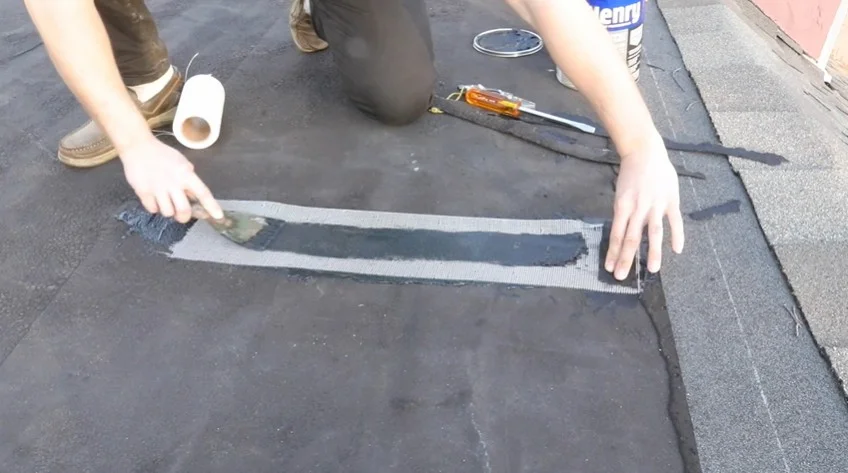
A real repair starts with diagnosis, not a bucket of sealant. Here’s the sequence a competent roofer follows:
- Find the water — all of it. Surface leaks lie. A proper diagnosis starts with a moisture survey: nighttime infrared thermography (wet insulation holds heat differently) plus electrical impedance scanning, confirmed with small core samples. If you’ve got recurring stains or soft spots, this is what finds the full extent before anyone cuts or patches.
- Shut down the leak path. Seam re-welding (TPO/PVC), adhesive seam repair and patches (EPDM), torch or cold-applied patching (mod-bit) — matched to the membrane, not one-size-fits-all.
- Re-work the flashings. Parapets, curbs, penetrations, edge metal — the transitions get stripped back and rebuilt properly. Most “mystery leaks” live here.
- Fix the drainage. Clear every drain and scupper. If ponding persists past 48 hours after clearing, the fix is tapered insulation or added drains — not more sealant on a roof that can’t shed water.
- Document everything. Dated photos of the defect, the repair, and the finished work. If your roof is under warranty, repairs should use an authorized applicator with compatible materials — unauthorized work can void coverage for that area. Keep the paper trail regardless.
Water coming in right now? Don’t wait for the next storm to finish the job.
Call (813) 471-5632 — 24/7 emergency flat roof repair in Riverview
Repair vs. Recoat vs. Replace: How to Decide
This is the question that actually matters, and most roofers won’t walk you through it honestly. Here it is straight:
Repair it — when the damage is local and the rest of the roof is dry and mid-life — an isolated seam, a single puncture, one bad flashing. Targeted, minimal, done.
Recoat it (silicone or acrylic restoration coating) — when the roof is aging but structurally sound and DRY. A quality coating buys 10–15 more years at a fraction of replacement cost — it seals small cracks and restores reflectivity. The honest caveat, and it’s a big one: a coating on a wet, spongy roof is a lid on a problem. Coating over saturated insulation traps the moisture and guarantees a bigger failure later. Any roofer who’ll coat without a moisture survey is selling, not advising.
Replace it — when: moisture has spread through the insulation (the IR survey says so), the deck itself is compromised (rot, rust, spalling concrete), the membrane is failing system-wide (severe blistering, cracking, detachment), leaks keep recurring after repairs, the roof is at end of service life — or you’re about to trip Florida’s 25% rule (next section).
If replacement ends up on the table, see our roof replacement cost page — Riverview pricing, no fluff.
What Flat Roof Repair Costs in Riverview
Typical ranges for our market — not quotes. Every roof is different, and honest pricing starts with someone actually walking yours.
| Job | Typical range |
|---|---|
| Minor repair (small leak, sealant, small patch) | $150–$500 |
| Typical repair — single isolated defect (one seam run, one patch, one flashing) | $300–$1,100 |
| Leak diagnosis & repair — full leak tracing plus the fix, often across multiple penetrations or a hard-to-find entry point | $500–$1,200 |
| Moderate (membrane patch, flashing rebuild, blisters) | $700–$1,500 |
| Major (extensive damage, structural involvement) | $1,500–$5,000+ |
| Per square foot of repaired area | $2.50–$10 |
| Roof coating / restoration | $1–$4 per sq ft |
| Full replacement | $4,000–$16,800 |
What moves your number: roof size, membrane material (TPO and PVC run more than mod-bit), how far the damage has spread, roof access (difficult access adds cost), warranty requirements, and whether replacement means tear-off and disposal.
Deeper dive: 2026 roof replacement price guide — the full cost breakdown, Riverview FL.
Florida’s 25% Rule: What It Means for Your Repair
This is the single most financially consequential thing on this page, and almost nobody explains it before you’re standing in it.
The rule: under the Florida Building Code, you can’t repair, replace, or recover more than 25% of your roof area (or roof section) in any 12-month period — unless the entire roof or section is brought up to current code. Cross that line and a “repair” legally becomes a full code-compliant replacement.
The exception that saves many owners: a 2022 state law (SB 4-D) says if your roof was built, repaired, or replaced under the 2007 Florida Building Code or later — meaning a permit dated on or after March 1, 2009 — then only the repaired portion has to meet current code. No forced full replacement.
What to do: pull your permit history before your roofer or your insurer tells you what you “have to” do. Pre-March-2009 roof approaching 25% in repairs within a year? That’s the classic trap — and it’s exactly when you want the repair-vs-replace math done honestly, not under pressure. (Confirm the specifics with your local building department — code language is precise and your situation is specific.)
Related: How to file a roof insurance claim in Florida — the claims playbook.
Storm and Hurricane Damage to Flat Roofs
Hurricane season runs June 1 through November 30, and they fail in predictable ways when it hits:
- Wind uplift starts at the edges. Lifted edge metal and coping is the documented starting point — once the edge goes, the wind gets under the membrane.
- Torn and peeled seams, especially on older EPDM with taped seams.
- Debris punctures — branches, loose equipment, anything the wind picks up.
- Clogged drains — storm debris blocks drainage, and then you get ponding on top of wind damage.
The honest timing advice: get known defects repaired in spring, before June. Emergency storm work costs more, waits longer, and happens when every roofer in Hillsborough County is booked solid. A $400 seam repair in April beats a $4,000 interior-damage claim in September.
Related: Hail damage roof repair in Riverview, FL — storm damage service.
Keeping It From Coming Back
- Inspect twice a year — spring (before hurricane season) and fall (after it). In Hillsborough County, time the fall inspection for late November or December: after six months of storms, one post-season walk catches edge-lift, torn seams, and clogged drains before winter rains work into them.
- Keep drains and scuppers clear. Five minutes with a blower beats a ponding-water failure.
- Walk the seams. Look for lifting, cracking, or separation — catch it at the hairline stage.
- Watch dark membranes in summer. Florida UV ages black EPDM and granule-worn mod-bit noticeably faster than white reflective systems — if your roof runs dark, summer is when small problems become big ones.
- Limit foot traffic. Every service tech with a toolbox is a puncture risk. Use walk pads on traffic paths.
- Consider a maintenance plan. Scheduled inspections, drain clearing, and minor seam touch-ups cost a fraction of one emergency leak call.
Flat Roof Repair FAQs — Riverview, FL
How long does a flat roof repair take?
Most repairs are a half-day to a full day. Moderate work (flashing rebuilds, multiple patches) runs 1–2 days. Full replacements are a different project entirely — days to weeks depending on size.
Can you repair a flat roof in the rain?
Emergency temporary stops, yes — that’s what 24/7 is for. Permanent membrane work needs dry conditions: adhesives don’t cure and welds don’t hold on wet surfaces. Anyone promising a permanent repair in a downpour is cutting corners.
Will a repair void my roof warranty?
It can, if done wrong. Repairs on a warranted roof should use an authorized applicator with manufacturer-compatible materials. Keep dated photos of every repair regardless — paper trail protects you.
Does homeowners insurance cover flat roof repair?
Sudden storm damage — usually yes, subject to your deductible and policy terms. Gradual wear, ponding neglect, and age — usually no. Document everything with photos and call before you authorize big work. (See our insurance claims guide linked above.)
How long will the repair last?
A proper material-matched repair on a sound roof lasts years — often the remaining life of the membrane. A smear of sealant over a wet seam lasts until the next hard rain. The difference is diagnosis.
Coating or repair — which first?
Repair first, always. Coating is a restoration step for a dry, sound roof — not a substitute for fixing defects. Coating over problems just hides them until they’re expensive.
Do I need a permit for a flat roof repair in Riverview?
Minor repairs typically don’t; larger work does, and anything approaching the 25% rule definitely does. Your roofer should handle permitting — if they suggest skipping it, that’s a red flag.
How do I know if I need repair or full replacement?
The moisture survey decides. Dry insulation + local defects = repair. Widespread wet insulation, compromised deck, or system-wide membrane failure = replacement. Anyone who answers without looking is guessing.
Serving Riverview & Surrounding Areas
Riverview · Brandon · Valrico · Gibsonton · Apollo Beach · Ruskin
Stop the Leak Before the Next Storm
Every leak you’ve got right now gets worse with the next downpour — and in Riverview, the next downpour is never far off. One call, and you’ll know exactly what you’re dealing with: repair, recoat, or replace, with honest numbers.
24/7 Emergency Service · Inspections